Civil Service Examination
Subprofessional Civil Service Exam reviewer
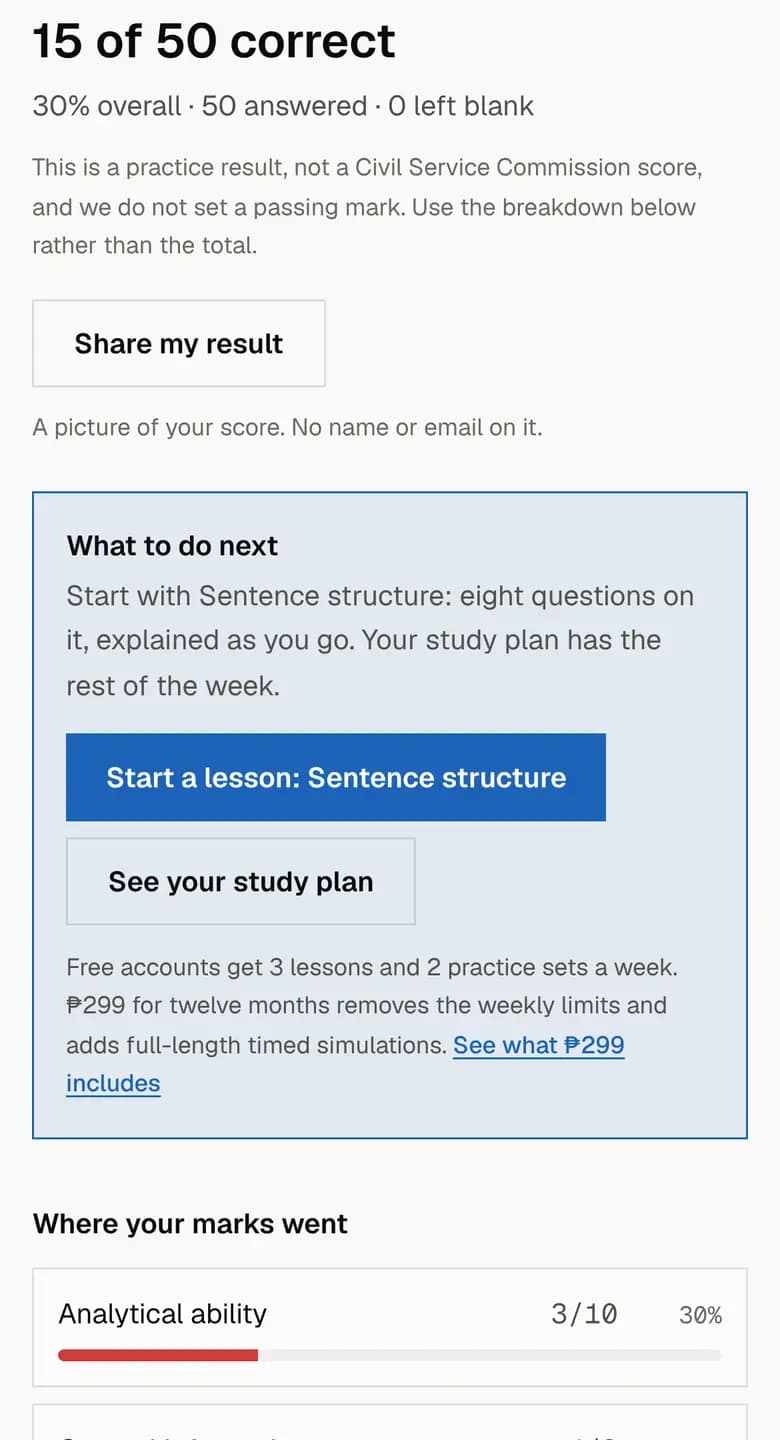
The Subprofessional examination covers numerical ability, verbal ability in English and Filipino, clerical ability, and general information. This platform gives you a free 50-question diagnostic across all four, then a study plan built from where you actually lost marks.
18,000+ practice questions written for this level, each with a worked explanation, and a 145-item timed mock exam that draws a fresh paper every time.
Coverage
What the Subprofessional paper asks about.
| Area | What it covers |
|---|---|
| Numerical ability | Basic operations, fractions and decimals, percentages and ratios, number series, word problems |
| Verbal ability | Vocabulary, grammar and correct usage, paragraph organization, and reading comprehension, in English and Filipino |
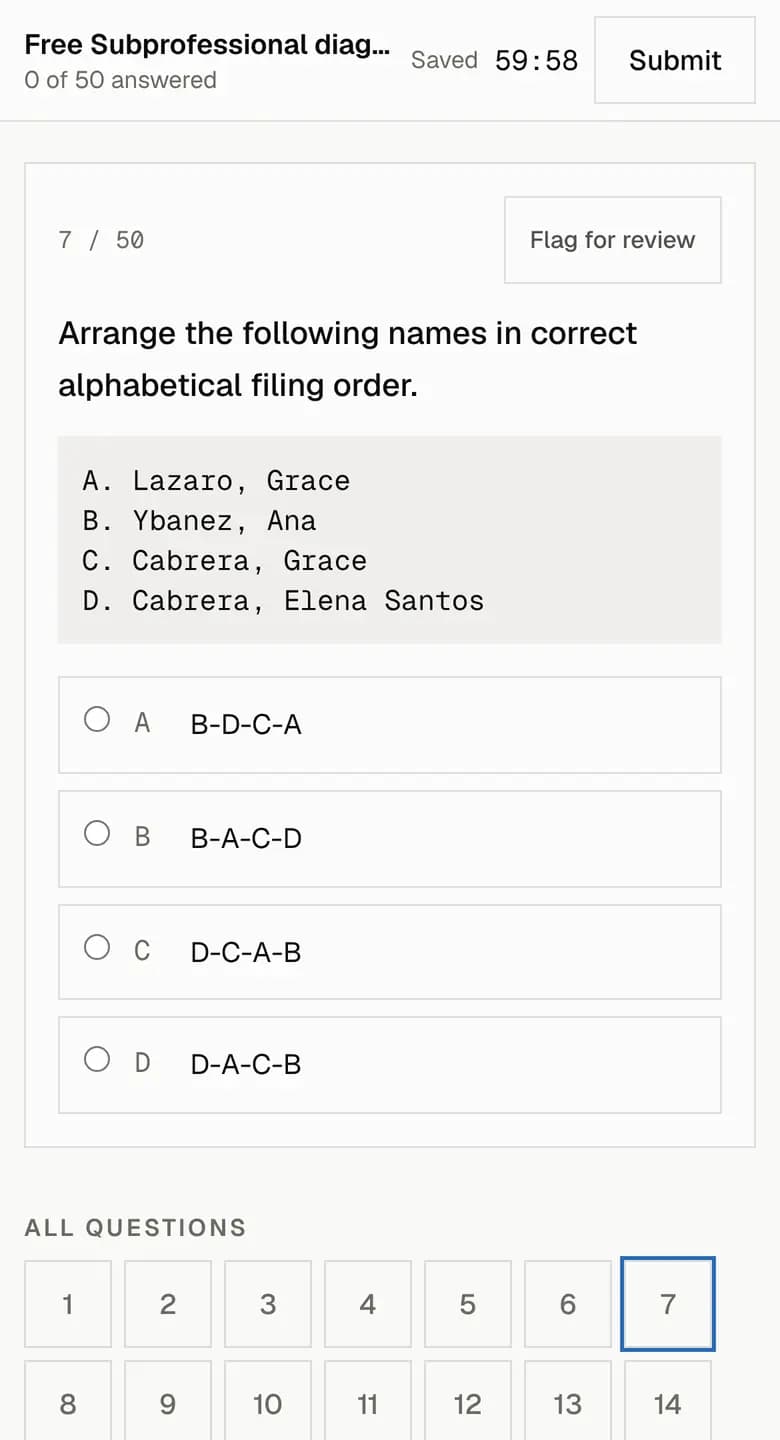
| Clerical ability | Filing and alphabetizing, and spelling |
| General information | The Philippine Constitution, the Code of Conduct and Ethical Standards for Public Officials and Employees, peace and human rights, and environment management |
Summarised from the Commission’s published examination scope. We are not affiliated with the Civil Service Commission and this is not an official statement of coverage; check the Commission’s own announcement for the examination you are sitting.
Practice by topic
Start where you are weakest.
Each topic page explains the format and works through real examples from our own bank, with every wrong option explained.
- Number and letter seriesA series question gives you four or five terms and asks for the next one. The whole task is naming the rule that produced them.
- Percentages and ratiosAlmost every percentage question on the exam is one of three forms: what is P% of N, N is P% of what, and N is what percent of M.
- Fractions and decimalsConverting between fractions, decimals and percents, and adding, subtracting and multiplying fractions - all of it without a calculator.
- Word problemsA word problem hides one equation inside a situation. Name the unknown, write what the sentence says about it, then solve.
- Work problemsWork problems are solved with rates, not times: a job done in 6 hours is 1/6 of the job per hour. Add the rates of people working together, then invert.
- Vocabulary and word meaningVocabulary items give you a word inside a sentence and ask for the closest meaning. The sentence is there to be used.
- Grammar and error recognitionError recognition prints a sentence in lettered segments and asks which segment is wrong - or whether none of them is.
- Paragraph organizationYou are given a paragraph's sentences out of order and asked to put them back. Exactly one order is right.
- Filing and alphabetizingFiling items give you names and ask which order they belong in under standard alphabetic filing rules.
- SpellingSpelling items print several versions of a word and ask which is correct.
- Wastong gamit: ng and nang, rin and dinThese items print four Filipino sentences and ask which one is correctly written. Most turn on a small set of word pairs that sound alike: ng and nang, rin and din, raw and daw.
- Kasingkahulugan at kasalungatThese items give a Filipino word, usually inside a sentence, and ask for the word closest in meaning (kasingkahulugan) or most nearly opposite (kasalungat).
- Kawikaan at matalinghagang salitaThese items print an idiom or a figurative expression in a sentence and ask what it means. The answer is always the figurative meaning, never the literal one.
- Pagkilala sa maliA Filipino sentence is printed in lettered parts, and you choose the part that is wrong in formal written Filipino - or E if the sentence has no error.
- Pagsunod-sunod ng pangungusapFour or five Filipino sentences are printed out of order, and you choose the order that makes the most logical paragraph.